

Miriam Rodríguez — Justice, Improvised
A case study in cartel violence, vigilante justice, and the cost of letting systems collapse into silence.

MODUS OPERANDI
Filed Case No. 003 — Cartel Violence · Vigilante Justice · Institutional Failure
Subject: Miriam Rodríguez Martínez
Date: January 2014 – May 2017
Location: San Fernando, Tamaulipas, Mexico
Classification: Cartel Violence · Vigilante Justice · Institutional Failure
Status: Closed (Primary perpetrators identified) — Open (Systemic accountability unresolved)
CASE SUMMARY
This case examines what happens when a state collapses into silence.
Between 2014 and 2017, Miriam Rodríguez Martínez, a mother, with no law enforcement training and no institutional backing, identified, tracked, and delivered at least ten members of a cartel cell responsible for the kidnapping, torture, and murder of her daughter.
She did so using basic surveillance, social engineering, disguise, and pattern recognition.
She succeeded where the state did not. Her work ended the same way it began: with impunity intact.



Rodríguez studied her suspect’s habits; she memorised their addresses, researched their friends, and stalked their lovers.
It didn’t matter how high the stakes were; she dyed her hair, masqueraded as an election official and exploited unknowing family members for information.
She was a one-woman private investigation squad hunting down her daughter’s kidnappers and killers across Mexico. In three years, she single-handedly tracked down 10 men involved in her daughter’s torture and death.
As William Congreve would have put it,“Hell hath no fury as a mother scorned.”
I. HELL HATH NO FURY
Miriam Rodriguez was digging through dirt in an old, abandoned ranch outside San Fernando, Tamaulipas, in Mexico, when she found a scarf.
She was not a detective. She was a mother tracing the first piece of evidence left behind after the abduction of her 20-year-old daughter, Karen Alejandra Salinas Rodríguez in 2014.
The discovery re-invigorated Karen’s case, allowing the police to uncover more gruesome remains buried beneath the sea of dirt.


Police would later find Karen’s femur in the same location as well as what turned out to be a mass grave with dozens of other victims’ bodies around the area.
Miriam immediately suspected the Mexican cartel of taking her daughter away, but the cartel wasn’t just another killer; it was an organisation of perpetrators.
The violence and power of the cartel were no shock, and the havoc being wreaked on the territory had been clear for a long time. Citizens and police were tormented by the organization’s members for decades; by then, the potential of having a family member disappear into the night, never to return was a common occurrence.
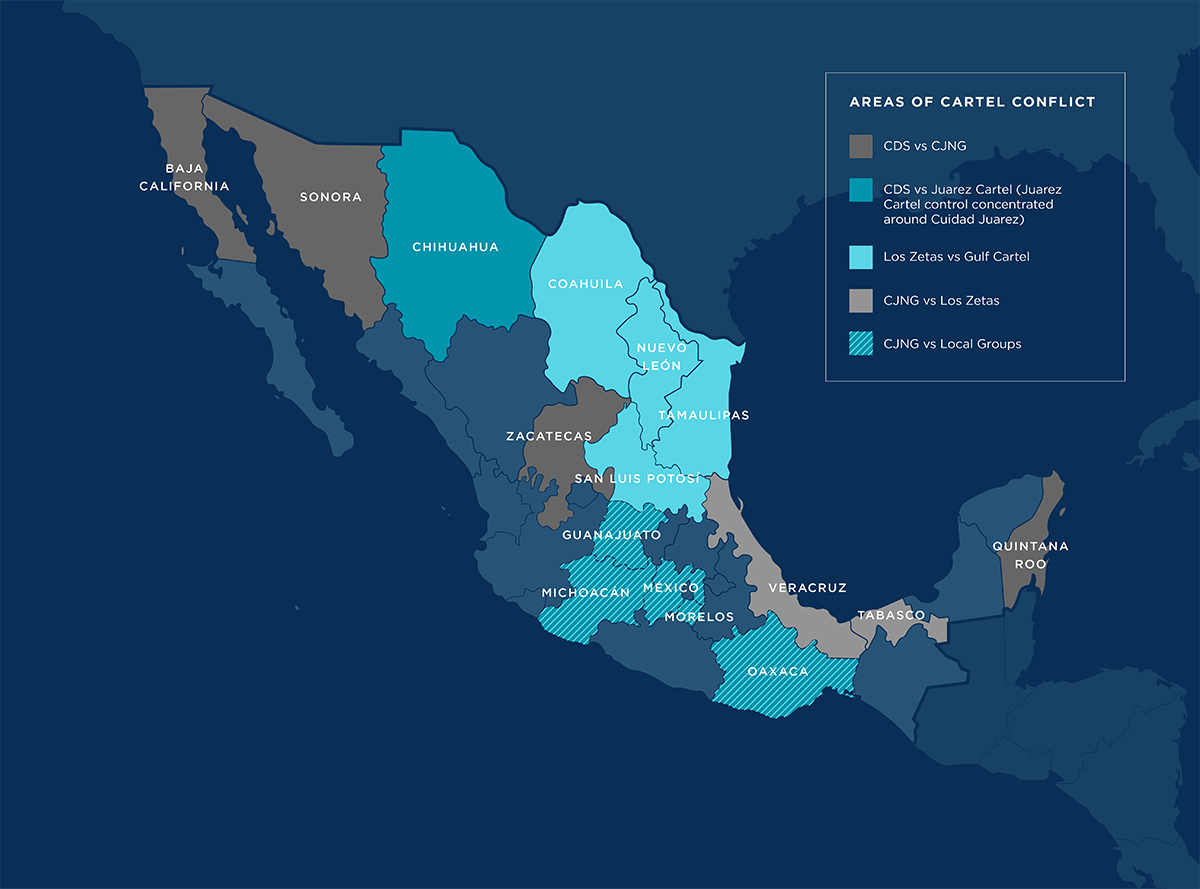
Rodríguez was up against over 70,000 cases of missing people due to cartel activity. Homicide rates had doubled in Mexico, and no one was doing anything about it.
Rodríguez took the case into her own hands and began a Crusade that would span years and lead her to some of the most dangerous people in the country, to bring her daughter’s killers to justice.

Back in 2014, the San Fernando community was still grieving from the 2011 massacre by the Mexican cartel. About three years earlier, a subsection of the Gulf cartel, known as Los Zetas, slaughtered almost 200 people.
Most of the victims had been kidnapped from bus hijackings, they were stolen from their families and likely trafficked to fund the cartel war. Meanwhile, those who tried to escape didn’t get far. Their remains were found in mass dumping grounds around the abandoned ranch area, the same place Miriam found her daughter’s scarf.
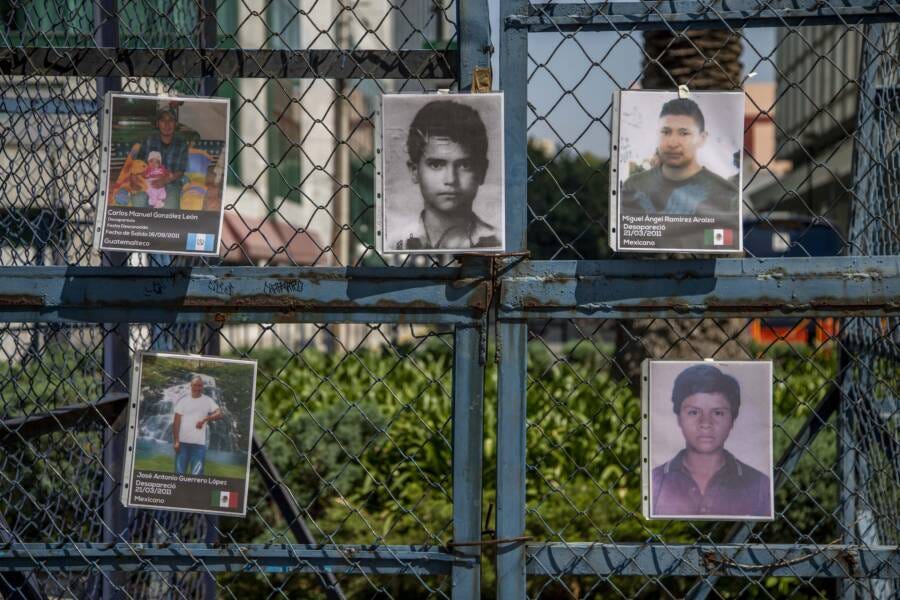
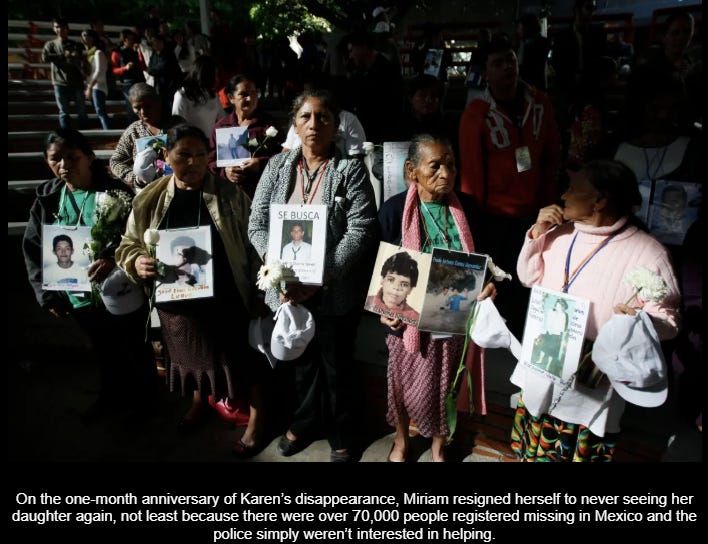
The community was terrified by the seemingly unconquerable power of the cartel, it led to a mass exodus from the region, this included Rodriguez’s other child, her son Luis.
Luis, like many others, fled to escape the danger of San Fernando; however, Karen chose to stay and finish up her education as well as help out at her mother’s cowboy store, “Rodeo Boots.”
II. ABDUCTION & RANSOM
Karen was twenty years old and was driving through a rural area near San Fernando when two vehicles boxed in her truck. Armed men forced her into their car and drove to her family’s home, binding her with rope while waiting for instructions.The plan fractured when a family friend arrived unexpectedly.
Unwilling to risk witnesses, the abductors took both captives and fled.
The friend was released shortly afterward.
Karen was not.
Miriam Rodríguez and her husband had no problem obtaining a ransom loan from the bank; the city had seen so many abductions that the bank offered specific money borrowing payments for ransoms.
The cartel’s tedious demands were:
For the Rodríguezs to drop off the money at a nearby health clinic.
Then wait for further instruction in a nearby cemetery.
But no call came.
The Rodríguez couple was never contacted as they made numerous attempts to bring their daughter home. Even going as far as to meet up with a member of the cartel, who allegedly went by the name “Sama”, who claimed that they didn’t have Karen but that he could help, for a small fee.
The desperate mother gave the gang $2,000 as compensation; however, the gang never contacted her back until they asked for an additional $500.
Once again, however, the gang took the money and ran.
III. SYSTEM FAILURE
Officially, Karen became one of more than 70,000 missing persons tied to cartel violence in Mexico. Unofficially, she became invisible.
Police opened no meaningful inquiry. Leads were not pursued. Files stagnated.
The Rodríguez family maintained hope for their daughter’s return until Miriam, who was now separated from her husband and living with her older daughter, Azalea, predicted that Karen would never be coming home.


The family’s matriarch vowed that she wouldn’t stop until she found those responsible for what happened to Karen.
She decided to start with her “informant”: Sama.
IV. INVESTIGATION
The family friend who had unknowingly walked in on Karen and her abductors had been released. Although he was not deemed valuable to the cartel, his recollection of the abduction day was worth everything to a mother searching for her daughter.
The friend was able to confirm that Sama was involved in Karen’s kidnapping. With that in mind, Miriam scoured social media platforms for any trace of her informant.

She eventually discovered a photograph of a man on Facebook, resembling Sama standing next to a woman wearing a uniform of an ice cream shop. Further research revealed that the uniform belonged to a shop two hours away in Ciudad, Victoria.
Like cat and mouse, Miriam stalked her prey, waiting outside the ice cream store for weeks, until she was finally able to track down the woman who appeared to be Sama’s partner.
V. FATE INTERVENES
Miriam disguised herself as a Health Ministry worker using a uniform left over from a previous job. It wasn’t an elaborate cover. It didn’t need to be. Dressed as a government employee, she knocked on neighbors’ doors under the pretense of conducting a local survey—visible, official, and unremarkable.
At this stage, Miriam wasn’t seeking revenge. Not yet. She wanted answers. More precisely, she wanted something the authorities could not ignore. Her hope was that if she gathered enough information herself, the system might finally do its job.
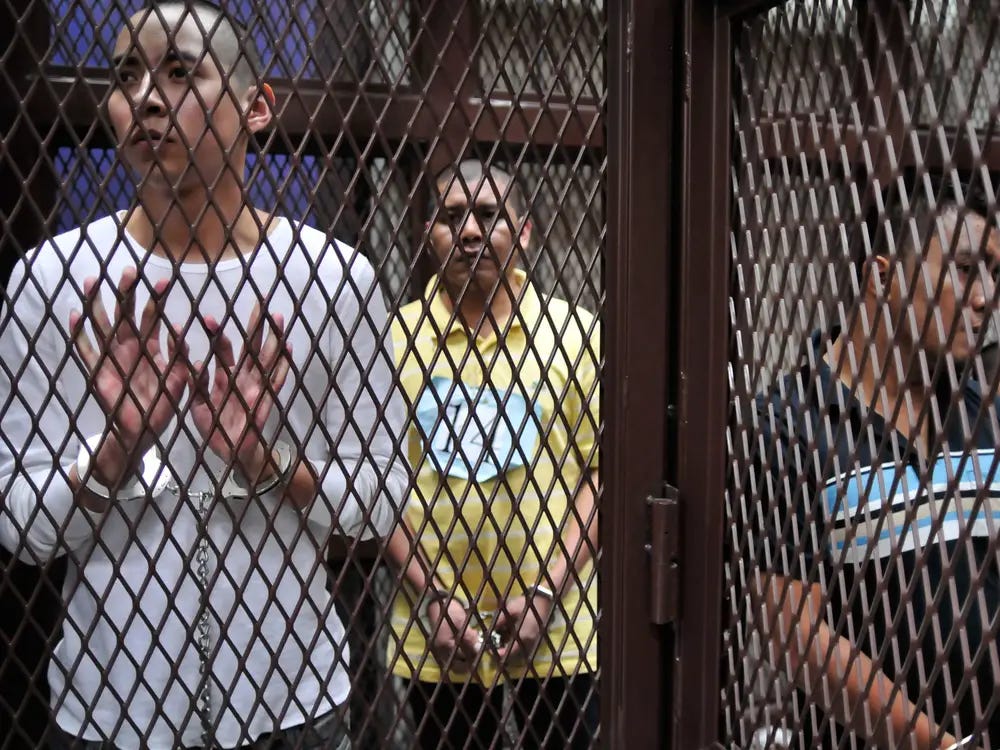
With evidence from her investigation and testimony from the family friend who had witnessed the abduction, Miriam had enough for police to arrest Sama on reasonable suspicion. A warrant was issued, but Sama disappeared.
What followed felt less like progress and more like coincidence disguised as fate.
Luis, who had moved to Ciudad Victoria to distance himself from cartel violence, spotted Sama while closing his store one evening. This time, Sama did not vanish. He was arrested and interrogated. Almost immediately, he named others involved in Karen’s abduction—including Zapata González, an eighteen-year-old whose age stunned Miriam when he was taken into custody.
Miriam later said it wasn’t force that broke him. It was calm. Familiarity. A mother speaking to someone who still believed he could be seen as a person.
Zapata led Miriam to an abandoned ranch pockmarked with bullet holes; its front yard slowly swallowed by dirt and neglect. There, Miriam found the object that ended all remaining ambiguity: her daughter’s scarf.
The discovery triggered a larger excavation. Bodies surfaced—dozens of them. It was only after Miriam demanded a second search that Karen’s femur was finally recovered.
The case moved forward not because the system accelerated, but because Miriam refused to let it stall.
Another break came not through strategy, but attention.
While eating at a restaurant near the ranch, Miriam recalled an acquaintance—Elvia Yuliza—whose behavior had always felt evasive, misaligned with the situation around her. A brief search confirmed what instinct had flagged: Yuliza had ties to the cartel. She had been romantically involved with one of the abductors already in prison.
Phone records later showed that ransom calls had been made from Yuliza’s home. She was arrested.
From there, the pattern repeated.
Miriam tracked down Enrique Flores, a born-again Christian, by gathering information from his grandmother and quietly observing him during church services. Years later, her investigation led her to a florist whose behavior drew her attention. She followed him to the Texas–Mexico border. When he recognized her as Karen’s mother, he ran. Miriam tackled him and held him at gunpoint until police arrived.
The method was consistent: observe, verify, expose.
VI. THE PRICE OF JUSTICE
Over the years, Miriam received relentless death threats from cartel members and their families alike. She did not stop.
After three years of sustained, methodical pursuit, she had helped identify or locate nearly all ten of the living individuals involved in her daughter’s abduction and murder.
Her work brought her national attention. It also brought visibility she could not outrun. To outside observers, Miriam was a woman in her fifties taking on an organization with thousands of members and decades of territorial control.
She did not retreat after her initial successes. Instead, she widened the scope of her work, advocating for other families whose children had disappeared under similar circumstances.
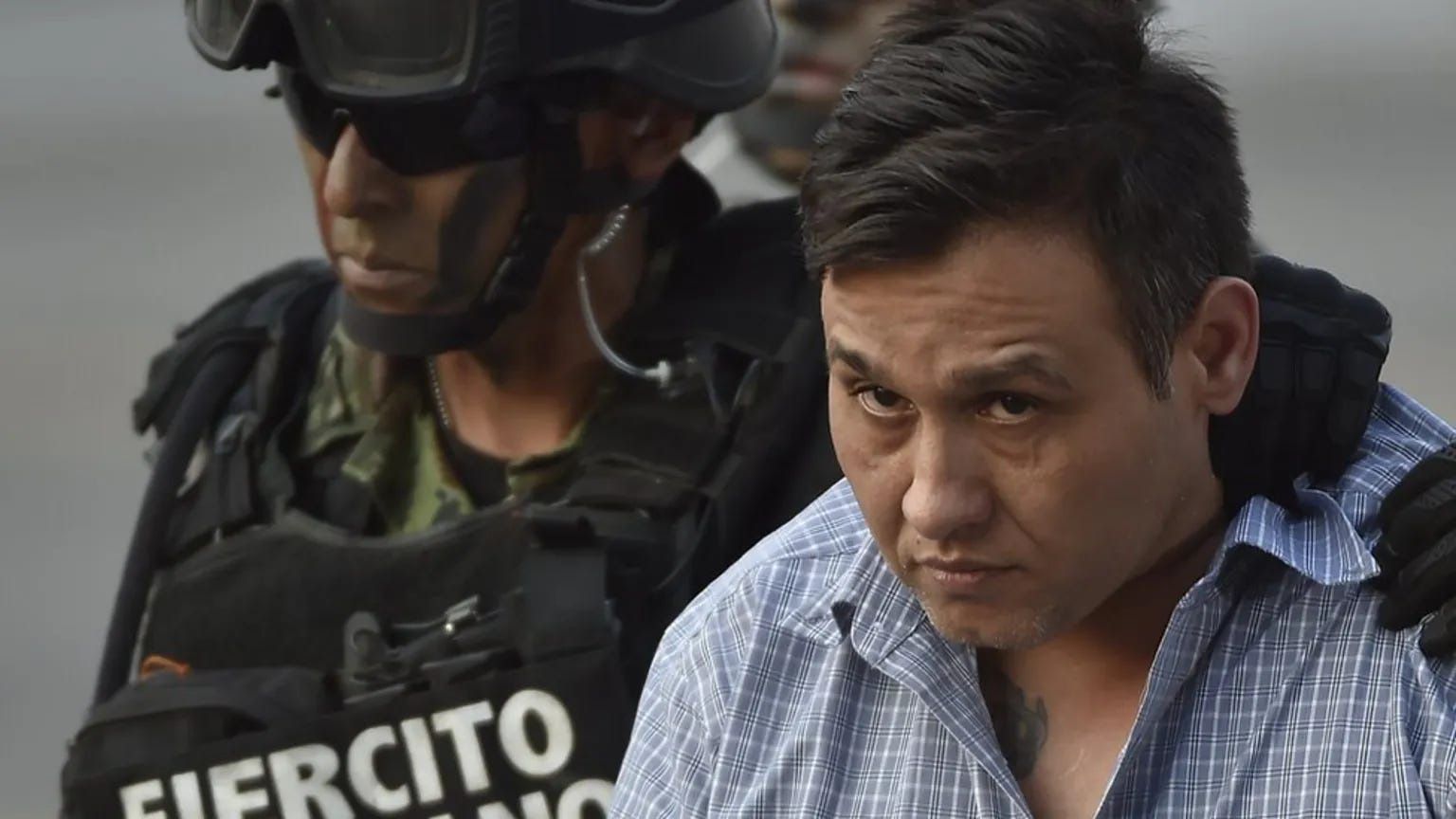
In 2017, Miriam Rodríguez was shot and killed outside her home on Mother’s Day in San Fernando, Tamaulipas. Weeks earlier, she had turned over another suspect connected to Karen’s murder. Even with an armed government escort, protection proved symbolic. The cartel’s reach was faster.
A plaque was later erected in her honor. Authorities pledged to find her killers.
VII. POSTHUMOUSLY
After her death, Luis assumed leadership of Colectivo de Desaparecidos de San Fernando, the support group Miriam had founded for families of the disappeared.
At its height, the collective had over 600 members. Following Miriam’s assassination, participation declined sharply. Fear resumed its work.
Even so, her investigation continued to yield results. One month after her death, a woman in Veracruz was arrested based on information Miriam had already provided. She was intercepted while fleeing San Fernando with her son. Authorities later confirmed she had participated in Karen’s torture, beating her while she was suspended by her wrists during captivity.
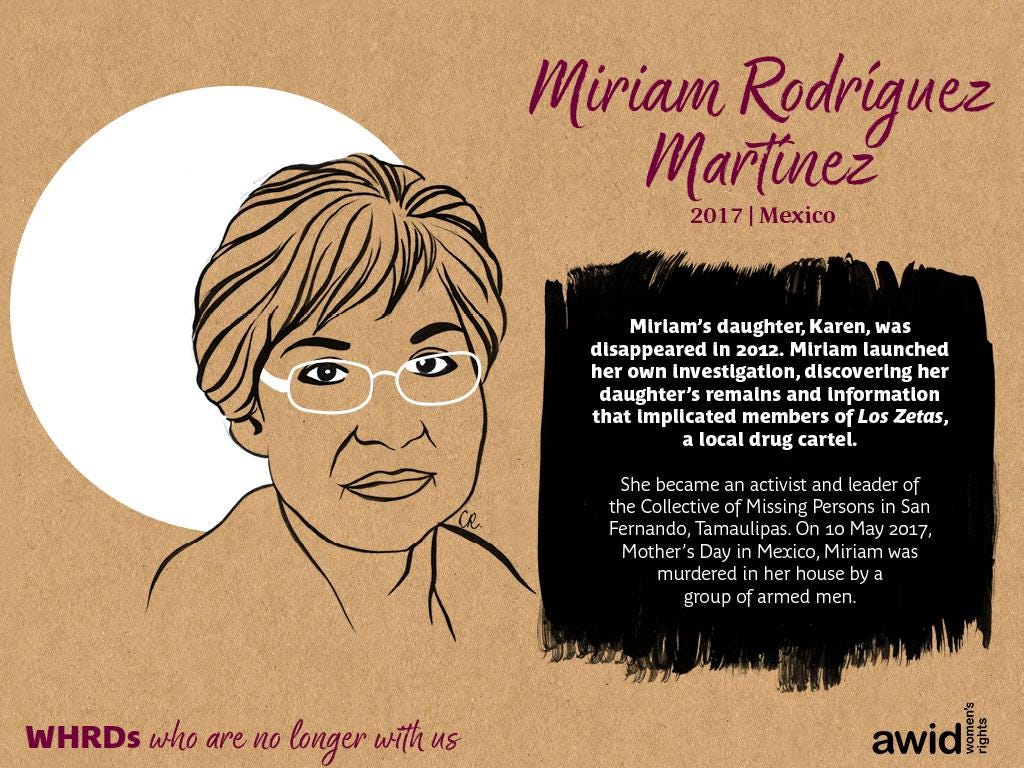
Since 2011, violence in Mexico has only intensified, driven largely by cartel activity.
Miriam Rodríguez has been described as a vigilante, a symbol, even a hero. But symbols don’t replace systems.
Fear, retaliation, kidnapping, torture, murder, and trafficking continue to shape daily life in San Fernando. Families still wait. The longer the silence holds, the less likely answers become.
What Miriam proved was not that justice is inevitable, but that it is often outsourced to those with the least protection and the most to lose.
More from Mayday!


Citations/References
Omar Trevino Morales – BBC
Cartel Map – Global Guardian
San Fernando, Tamaulipas Ranch – Daily Mail
Mexico’s Disappeared from The Washington Post
The Grieving Mother Who Became An Angel of Vengeance from CrimeReads